



Thailand Has One Foot in the 2026 ASEAN Cup Final: A Pragmatic and Flexible "War Elephant"

17/08/2026 12:01:23 体育老手
 0
0  0
0The 3-1 win against Singapore in the first leg of the ASEAN Hyundai Cup 2026 semifinals demonstrates that Thailand, led by Anthony Hudson, can control the game and triumph without relying on high ball possession.
This is a notable shift for a team traditionally associated with technical play, short passes, and ball control. Thailand had only 28% possession in the first-leg semifinal but still won 3-1 and created enough chances to score additional goals.
From Ball Control to Moment Control
For years, Thailand was seen as the symbol of possession-based football in Southeast Asia. A pool of technically skilled players allowed the "War Elephants" to frequently build up with short passes, maintain compact spacing, and stretch the opponent's defensive lines.
Against Singapore, however, Hudson did not force his team to stick to that style at all costs. Thailand had only 28% possession, while Singapore pressed aggressively and often controlled the tempo. Yet the difference lay in the quality of attacking moves. Thailand capitalized on the gaps left by Singapore's turnovers and transitioned from defense to attack at high speed.
The opening goal in the 14th minute was a clear example. Singapore tried to build from the back, but Kyoga Nakamura lost the ball. Seksan Ratree immediately joined the counterattack, received a pass from Kakana Khamyok, and slipped a through ball for Teerasak Poeiphimai to run onto and finish. One moment of Singapore losing possession was turned into a goal by Thailand.
The second goal further showcased Thailand's ability to exploit space. Teerasak started from the central area, passed the ball to the right for Waris Choolthong, and immediately moved into the box. A precise cross from the Thai right-back found Teerasak, who headed in to make it 2-0 in the 26th minute.
Notably, Thailand did not need prolonged possession to create such chances. They controlled the timing of their attacks better. Singapore had more of the ball, but Thailand was the side that delivered more dangerous moments at crucial junctures.
Thailand not only took their chances better but also showed significant resilience under pressure. After going 2-0 up, they did not rush to reclaim possession. Instead, the visitors continued to wait for gaps to appear.
The third goal in the 51st minute was a product of that approach. Kakana Khamyok played a pass that sent Patrik Gustavsson sprinting down the left flank. The Swedish-born striker raced to the byline and cut the ball back for Seksan Ratree to score from close range. By then, Singapore had to push higher, and Thailand found even more room to play their game.
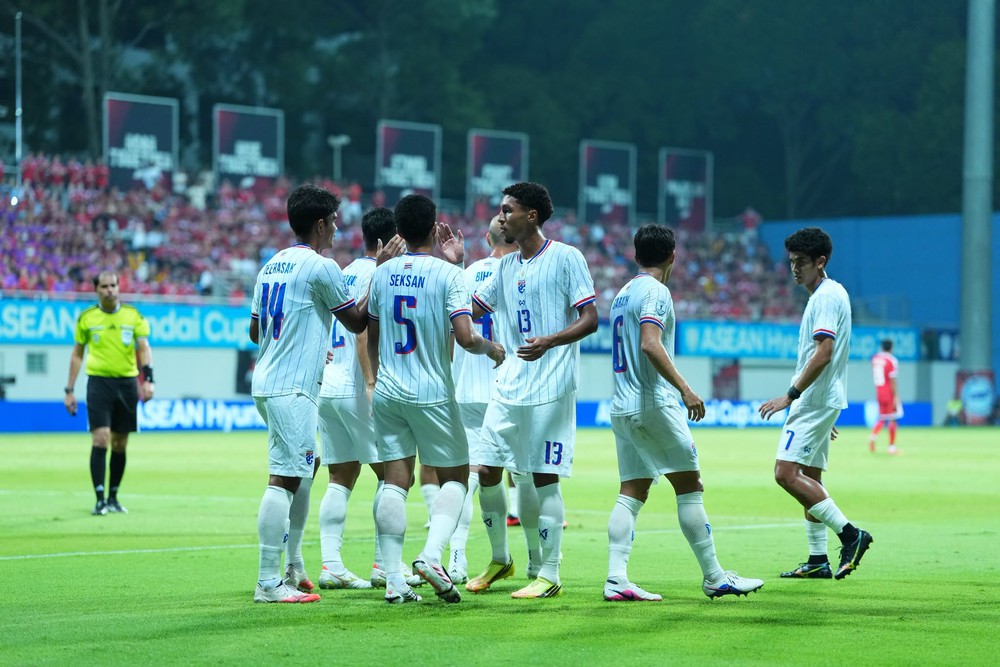
Thailand has one foot in the final after beating Singapore 3-1 in the first leg of the semifinals.
A More Flexible Thailand
Thailand's victory must also be seen in the context that Hudson did not have his full strongest squad, forcing him to explore different tactical options rather than relying on a fixed lineup or formation.
One notable solution was the use of a "false nine." Kakana Khamyok or Worachit Kanitsribampen could start as the central striker but often dropped between the lines to link play. Meanwhile, genuine strikers like Teerasak Poeiphimai or Yotsakorn Burapha could start wider and then move into central areas when space opened up.
What is more remarkable is that Hudson is trying to create multiple operational schemes simultaneously. Against Singapore, Thailand was willing to cede possession. When they needed to attack, they still had the ability to play short passes and close combinations. When the opponent pushed high, they had players with enough pace to exploit the space behind the defense.
Hudson himself stated that he wants Thailand to move toward a style based on close connections, short passes, and runs behind the defense. The English coach admitted that the match in Singapore did not go according to his possession plan, but he praised his players for defending well and taking their chances.
Personnel flexibility is also part of this process. Thailand made six changes to the starting lineup compared to the previous 2-0 win over Myanmar. Although these changes were partly due to match scheduling and squad availability, they show that Hudson is not building the team around a fixed group of players.
The approach against Singapore can therefore be seen as a successful test. Thailand did not control possession much, but they controlled the decisive moments. They did not apply constant pressure, but they were sharp enough when the opponent made mistakes. And when Singapore pushed forward to chase goals, Thailand maintained their counterattacking ability.
The first leg against Singapore showed a more pragmatic Thailand, but not a purely defensive-counterattacking team. They still want to control the ball—they just no longer see it as a mandatory condition for winning.


Wonderfulshortvideo

mbappe news mbappe edit mbappe new shoe boot deal mbappe nike



julian alvarez barcelona news
James Trafford’s big moment in the U21 EURO final 🤯

RODRI BARCELONA transfer barcelona news today rodri to barcelona transfer here we go
gianni infantino and trump drama news
jorge messi death messi news today football news today

jose mourinho netflix documentary pep guardiola mourinho beef mourinho edit
 Links
Links
 Contact